
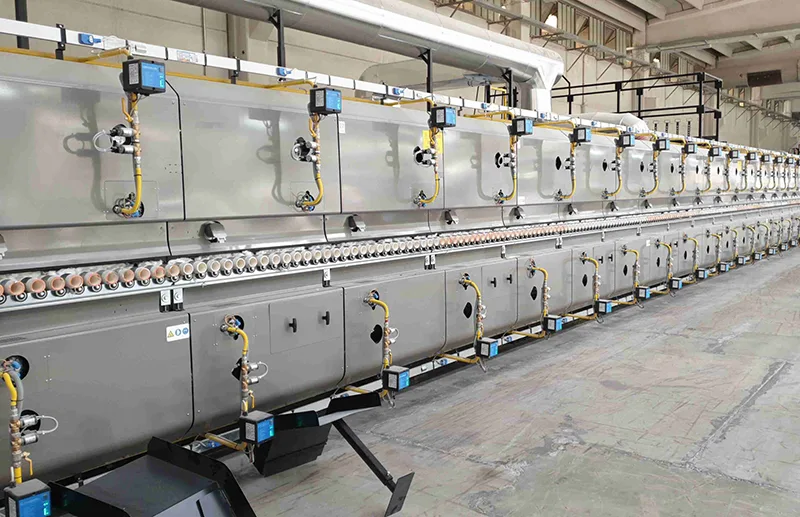
Delivery 1 of the Combustion Control System for the ceramic kiln.
From fixed air to modulated air
How the simultaneous regulation of air and gas improves the efficiency and stability of the firing process. In the Combustion Control System for the ceramic kiln, firing quality and energy efficiency depend directly on the balance between air and gas in each burner. However, a large proportion of installations still operate with fixed air systems, in which the air flow remains constant while only the gas is modulated. This configuration simplifies operation but limits process accuracy, reduces energy utilization and increases thermal variability within the furnace.
The Combustion Control System (CCS) was developed precisely to overcome these limitations. Its main function is to convert a burner operating with fixed air into a modulated air burner, allowing the air/gas mixture to be adapted in real time and according to process conditions.
Why evolve combustion control?
- Fixed air systems have intrinsic limitations:
- Inability to compensate for environmental changes (temperature, density, air pressure).
- Higher specific gas consumption due to frequent work with non-optimized mixtures.
- Variability in the kiln atmosphere, affecting the repeatability of the combustion control process for the ceramic kiln.
- Risk of thermal deviations that impact the final quality of the product.
With the increasing demand for energy efficiency and thermal stability, moving towards modulating control is not just a technical improvement: it is an operational requirement directly related to the Combustion Control System for the ceramic kiln.
What is the SCC?
The SCC is an advanced electronic control device that integrates a certified gas pressure transducer and an internal air pressure transducer fully integrated in its electronics.
Based on these signals, the system acts on an external air regulation valve, allowing the burner to switch from operating with a fixed flow rate to modulated air, adjusted in real time according to the thermal demand and power required. The Combustion Control System for the ceramic furnace ensures this optimum adjustment.
How does it work?
The operation of the SCC is based on three technical pillars:
- Automatic air valve control: the system regulates the air pressure supplied to the burner, automatically compensating for variations in air density or temperature. This continuous correction maintains a stable and efficient mixture within the context of the Combustion Control System for the ceramic kiln.
- Continuous adjustment of the air/gas ratio: the SCC calculates and adapts the mixture in real time, ensuring that the stoichiometric ratio remains constant throughout the burner power range. This guarantees a more uniform and controlled combustion.
- Technical history per production model: the system automatically records the history of settings made for each burner. This makes it possible to accurately reproduce the same conditions each time the plant works with a given tile model, format or firing curve.
This is especially valuable for plants that handle multiple curves and require absolute repeatability between batches.
Results
The use of the SCC makes it possible to achieve an optimum stoichiometric ratio by model, format or kiln curve, greater energy efficiency by reducing excess air and improving gas utilization, thermal stability, with less dispersion between cycles and burners and reduced fuel consumption and thermal wear.
Overall, the SCC is consolidated as a technical solution to achieve more stable, efficient and reproducible firing processes, adapting to the current requirements of the ceramic industry, being an integral part of the Combustion Control System for the ceramic kiln.


